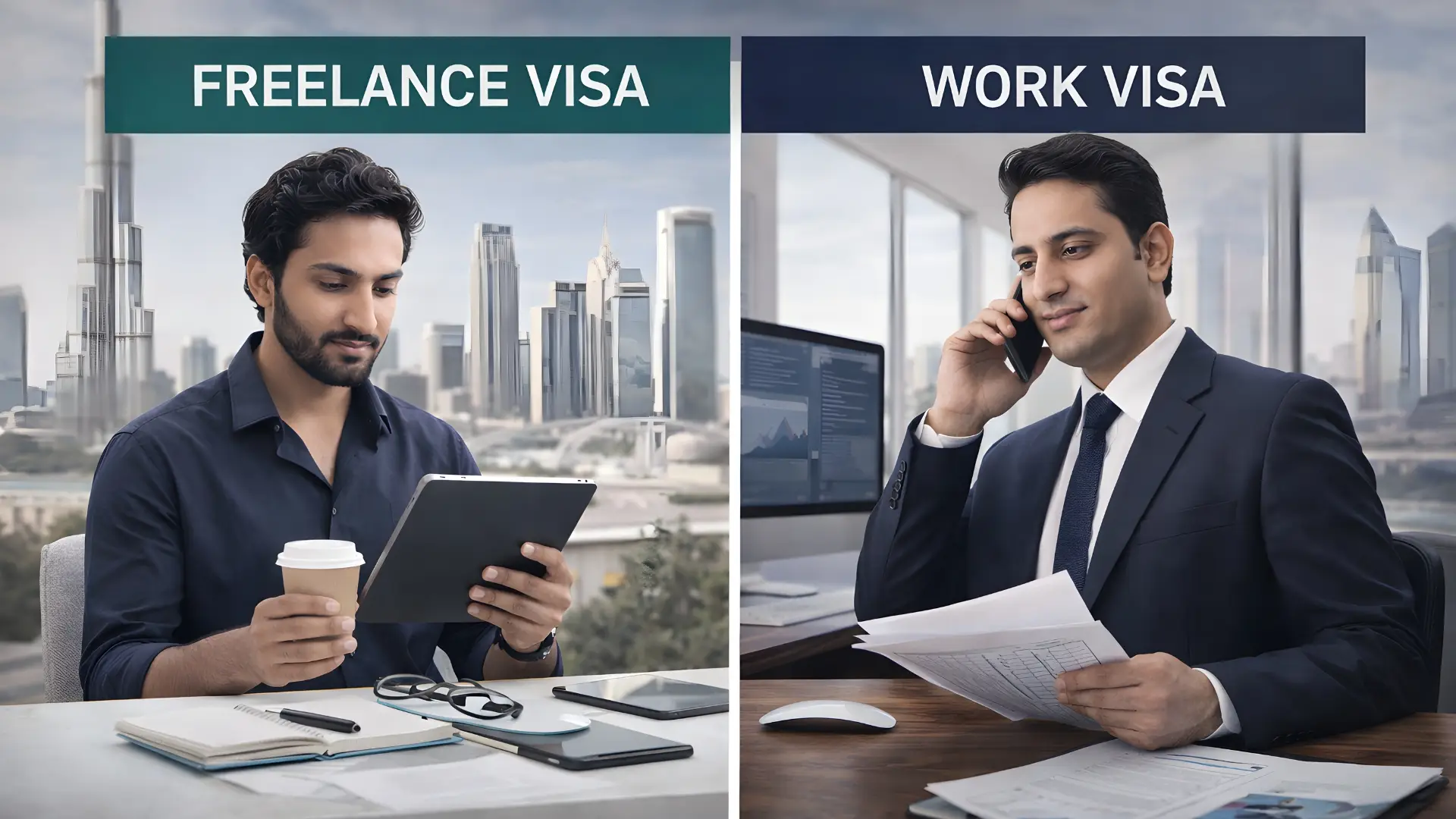
Imagine two people living in the UAE. One works as a freelancer, choosing clients and projects freely, while the other has a full-time job with fixed hours and benefits like health insurance. Both are working legally, but their work styles and lifestyle are very different.
In 2025, the UAE offers multiple visa options to support different types of workers, with the Freelance Visa and the Work Visa being the most common. This guide will explain the differences, including eligibility, documents, costs, benefits, and limitations, helping you choose the right visa for your career and lifestyle.
What is a UAE Freelance Visa?
A UAE Freelance Visa is a type of residence permit that lets you work independently. You don’t need a company to sponsor you. It allows freelancers to offer services to multiple clients legally while living in the UAE.
Who Can Apply and Common Professions
This visa is ideal for skilled individuals who want flexible work. Common professions include:
- Graphic designers, writers, and photographers
- IT professionals, web developers, and digital marketers
- Business consultants in finance, HR, and education
- Fitness trainers, yoga instructors, and wellness coaches
It suits anyone who prefers project-based work over a traditional job.
Where Freelance Permits Come From and Why People Choose Freelancing
Freelance visas are usually issued through free zones like:
- Dubai Media City
- RAKEZ
- SHAMS
- Abu Dhabi’s TwoFour54
People choose freelancing for flexibility, freedom to work from anywhere, control over income, and the chance to build their own brand.
What is a UAE Work Visa?
A UAE Work Visa is a residence permit that allows you to work for a specific employer in the UAE. Unlike a freelance visa, it ties you to one company and gives you legal permission to live and work while following the employer’s rules.
Employer-Sponsored Visa and Who Gets It
This visa is sponsored by a UAE-based company. It is usually offered to:
- Skilled professionals like engineers, accountants, IT specialists
- Semi-skilled and unskilled workers in hospitality, construction, or support roles
- Domestic staff such as nannies, drivers, or housekeepers
The employer handles the visa process and ensures that all legal requirements are met.
Benefits of a Structured Job and Why Companies Use It
Companies prefer work visas because they:
- Ensure employees are legally registered and compliant with UAE labor laws
- Provide stability and predictability for both the employee and the organization
- Offer benefits like health insurance, paid leave, and end-of-service gratuity
For employees, a work visa provides steady income, structured work hours, and access to company perks, making it ideal for those who prefer a stable career environment.
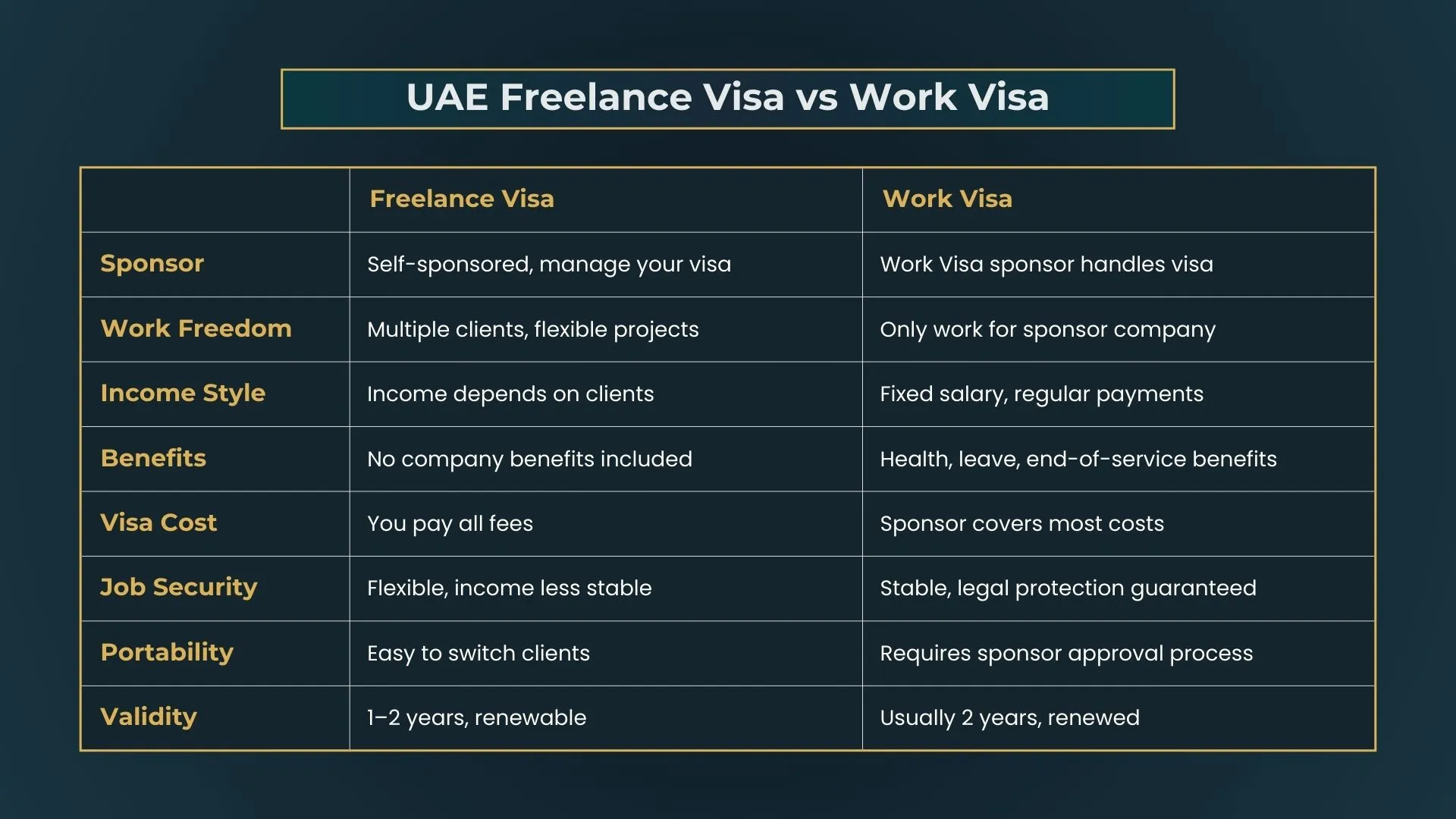
Freelance Visa vs Work Visa
Sponsor
Freelance Visa: You are self-sponsored and manage your own visa.
Work Visa: Sponsored by your employer, who handles the entire visa process.
Work Freedom
Freelance Visa: You can work with multiple clients and choose your projects.
Work Visa: You can only work for the employer who sponsors your visa.
Income Style
Freelance Visa: Income depends on clients and projects, so it may fluctuate.
Work Visa: Fixed salary with regular payments, providing stable income.
Benefits
Freelance Visa: No company benefits; you must arrange your own health insurance.
Work Visa: Enjoy health insurance, paid leave, and end-of-service benefits.
Visa Cost
Freelance Visa: You pay for visa stamping, medical tests, and Emirates ID.
Work Visa: Most costs are covered by the employer.
Job Security
Freelance Visa: Flexible work, but income is less stable.
Work Visa: Stable employment with legal protection under UAE labor laws.
Portability
Freelance Visa: High; you can switch clients and projects easily.
Work Visa: Low; changing jobs requires employer and government approval.
Validity
Freelance Visa: Usually 1–2 years; renewable via the free zone.
Work Visa: Typically 2 years; renewal is handled by the employer.
Eligibility Requirements
Freelance Visa Eligibility
To apply for a UAE Freelance Visa, you generally need:
- A valid passport with at least 6 months’ validity
- Proof of skills or qualifications in your field
- A portfolio or work samples showing your expertise
- A clean background check or criminal record certificate
- Compliance with specific free zone rules, which may include minimum income or client requirements
These requirements ensure that freelancers have the skills and credibility to work independently in the UAE.
Work Visa Eligibility
For a UAE Work Visa, you typically need:
- A valid job offer or employment contract from a UAE-based company
- Passport and relevant academic or professional certificates
- A medical fitness test confirming good health
- Clean background check
- Compliance with the employer and UAE labor laws
The employer usually manages most of the application process, making it easier for employees to meet these requirements.
Key Differences in Eligibility for Both Visa Types
Freelance Visa | Work Visa |
Focuses on individual skills and portfolio | Relies on employer sponsorship |
May need to prove existing clients or income | Only requires a valid job offer |
Offers flexibility but requires personal responsibility | Provides a structured and guided path |
Required Documents
Freelance Visa Documents
To apply for a UAE Freelance Visa, you typically need:
- Passport copy (valid for at least 6 months)
- Updated CV or resume
- Recent passport-sized photos
- Portfolio or samples of your work
- Freelance license or permit application
These documents help prove your skills and eligibility for independent work in the UAE.
Work Visa Documents
For a UAE Work Visa, you generally need:
- Passport copy
- Medical fitness test results
- Employment contract from your sponsor company
- Emirates ID application form
- Passport-sized photos
Most of these documents are provided or processed with the help of your employer.
Tips to Prepare and Organize Documents Efficiently
- Keep digital and physical copies of all documents ready.
- Check expiry dates on your passport and other certificates.
- Make sure your portfolio or CV is updated and relevant.
- Use a checklist to avoid missing any document during application.
- Some free zones may have specific requirements, so double-check before submitting.
Visa Validity & Renewal Process
Freelance Visa Renewal
A UAE Freelance Visa is usually valid for 1–2 years depending on the free zone. To renew, you must:
- Ensure your health insurance is valid
- Submit an updated freelance permit application online
- Provide proof of ongoing work or active clients if required
Renewing on time ensures you maintain legal status and avoid penalties.
Work Visa Renewal
A UAE Work Visa is typically valid for 2 years. The employer usually handles the renewal process, which includes:
- Submitting a new employment contract
- Completing a medical fitness test
- Updating the Emirates ID and other official documents
Employees usually do not need to manage the process themselves.
Renewal Tips to Avoid Delays or Rejection
- Start the renewal process at least one month before expiry
- Double-check that all documents are valid and up to date
- Maintain accurate records of clients and projects (for freelancers)
- Ensure your employer submits all required forms and approvals (for work visa holders)
Work Freedom & Legal Rights
Freelance Visa
With a UAE Freelance Visa, you enjoy a high level of independence:
- Work with multiple clients simultaneously
- Choose projects based on your interest and expertise
- No fixed working hours; you set your own schedule
- Control your earnings and invoice clients directly
This visa is ideal for those who value flexibility and self-management.
Work Visa
A UAE Work Visa ties you to a specific employer:
- Work for one company only
- Must follow company rules and working hours
- Receive a stable salary paid regularly
- Protected under UAE labor laws, including health insurance and end-of-service benefits
It suits professionals who prefer structure, stability, and employer support.
Legal Limitations and Rights of Both Visa Types
- Freelancers must comply with free zone regulations and cannot work outside approved activities without a permit.
- Work visa holders are restricted to their sponsoring employer and cannot freelance legally unless approved.
Both visas allow residency in the UAE and the ability to open a bank account, rent property, and sponsor family (if eligible).
Cost Comparison
Freelance Visa Cost Breakdown
Applying for a UAE Freelance Visa comes with several costs, including:
- Freelance license or permit fee (depends on the free zone)
- Visa stamping for residency approval
- Emirates ID issuance
- Medical fitness test
Freelancers usually pay all these costs themselves, which can vary depending on the free zone and service providers.
Work Visa Cost Breakdown
For a UAE Work Visa, most costs are covered by the employer, including:
- Visa stamping and processing fees
- Medical fitness tests
- Emirates ID issuance
Employees may only need to cover minor administrative fees, if any.
Benefits of Each Visa Type
Freelance Visa | Work Visa |
Freedom to choose clients and projects | Stable income with regular salary payments |
Ability to work remotely from anywhere | Health insurance and paid leave |
Opportunity to build your own brand | End-of-service benefits for long-term employment |
Work with multiple clients simultaneously | Easier access to bank loans and financial services |
Flexible lifestyle and independence | Structured career growth and security |
Disadvantages of Each Visa Type
Freelance Visa Cons
- No fixed income; earnings can fluctuate month to month.
- You are responsible for all paperwork, renewals, and compliance.
- No employer-provided benefits like health insurance or paid leave.
Work Visa Cons
- Cannot take side jobs or freelance without employer approval.
- Less flexibility in work hours and project choices.
- Must strictly follow company rules and policies.
How to Overcome or Manage These Disadvantages
- Freelancers: Keep a financial buffer, stay organized, and consider private health insurance.
- Work Visa holders: Manage your time well, seek flexible arrangements if possible, and focus on long-term career growth.
Which Visa Is Best for You? (Decision Guide)
For Those Who Want Flexibility
If you value freedom in choosing clients, projects, and working hours, the Freelance Visa is ideal. It allows you to work from anywhere and manage your own schedule while building multiple income streams.
For Those Who Want Security
If you prefer a steady salary, structured work hours, and company-provided benefits like health insurance and paid leave, the Work Visa is the better choice. It provides stability and legal protection under UAE labor laws.
For Those Who Want to Build a Business or Join a Company
- Build a business: Freelance Visa lets you create your own brand, work with multiple clients, and grow independently.
- Join a company: Work Visa provides a clear career path, promotions, and long-term growth within a structured environment.
Can You Switch Between Freelance and Work Visa?
Switching from Freelance to Work Visa
If you secure a job offer from a UAE company, you can transfer from a Freelance Visa to a Work Visa. The process involves canceling your freelance permit and applying for the new work visa through your employer.
Switching from Work to Freelance Visa
To move from a Work Visa to a Freelance Visa, you need to end your employment contract and obtain a No Objection Certificate (NOC) from your employer if required. Then, you can apply for a freelance permit in a chosen free zone.
Frequently Asked Questions
Freelance Visa is self-sponsored, allowing you to work with multiple clients and manage your own schedule. Work Visa is employer-sponsored, tied to one company, with structured hours and benefits.
Yes, if you meet minimum income and health insurance requirements. Free zone rules may apply.
No. Work Visa holders can only work for their sponsoring employer; freelancing without approval is illegal.
Freelance Visa costs are mostly paid by you. Work Visa costs are largely covered by the employer.
Yes, if you have skills or clients. Ideal for flexibility, but income may fluctuate and paperwork is self-managed.
Conclusion
If you want flexibility and control over your schedule, a Freelance Visa is ideal. It suits creatives, consultants, and anyone building a personal brand. A Work Visa is better for those seeking stability, a fixed salary, and company benefits, perfect for long-term career growth.
Choosing the right visa depends on your goals and lifestyle. Whether you want independence or security, Satti Services can guide you through the process. Contact us today for expert assistance with your Freelance or Work Visa applications and enjoy a hassle-free experience.